


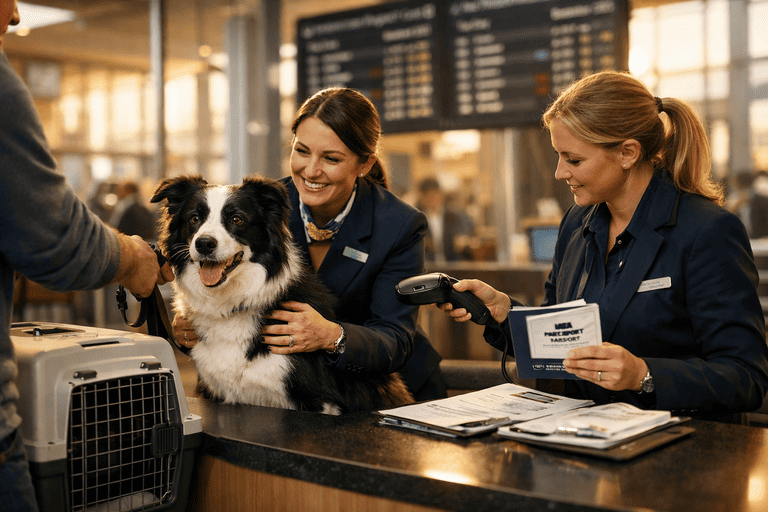
2026 is a turning-point year for international pet transportation. Major U.S. airlines have adjusted their policies, the International Air Transport Association (IATA) has released updates to its Live Animals Regulations (LAR), and the landscape for anyone flying with a dog or cat to or from the United States looks nothing like it did two years ago. If you are planning an international move, this guide will help you understand what changed, why it changed, and how to make sure your pet arrives safely.
IATA 2026: stricter rules for live animal transport
IATA updates its Live Animals Regulations (LAR) manual every year. It serves as the global reference for airlines, logistics operators, and airport authorities. The updates taking effect in 2026 aim to close compliance gaps identified in recent audits and to improve animal welfare in flight.
Among the most relevant changes:
- New container strength and ventilation standards for kennels used in the hold.
- Clearer specifications for brachycephalic breeds (flat-nosed) such as bulldogs, pugs, or Persians, with specific limitations and recommendations.
- Adjusted density and ventilation rules for special shipments, including day-old chicks.
- Reinforced rules for exotic and wild animals, including labeling and certification.
In practice, this means a kennel that was compliant in 2023 may no longer meet the new standards. Checking your kennel is now as important as keeping the rabies vaccine up to date.
U.S. airlines: who still carries pets and who does not
If you used to fly with your dog in the hold of a commercial flight, we have important news: the landscape has changed dramatically.
United and Delta: only military and diplomatic personnel in the hold
United Airlines and Delta Air Lines no longer offer pet transport in the hold to the general public. Both carriers have limited the service to active U.S. military members and U.S. Department of State / Foreign Service employees, with very narrow exceptions. For everyone else, only small pets in the cabin are accepted, provided they fit in a carrier under the seat.
American Airlines: similar restrictions
American Airlines has also restricted cargo-hold pet travel to military and State Department personnel. For the rest of the public, the practical option is in-cabin travel, with strict size and weight limits.
Alaska Airlines: the most pet-friendly in the U.S.
Alaska Airlines was recognized as the most pet-friendly airline in 2026 thanks to its flexible policies and a climate-controlled baggage compartment designed for pets that cannot travel in the cabin.
Updated fees
The three big U.S. airlines now charge around 150 USD per segment for a pet in the cabin, compared to roughly 100 USD just a few years ago. Only dogs and cats qualify for in-cabin travel, and carriers must meet strict dimensional limits.
When can I not fly with my pet? Seasonal embargoes in 2026
Seasonal embargoes are one of the least-known restrictions for pet owners. Many airlines limit pet travel between June and August on certain routes due to extreme heat, especially at airports where tarmac temperatures frequently climb above 85-90 °F (29-32 °C).
These embargoes mostly apply to cargo-hold travel, but in 2026 they are also being tightened for cabin flights with long layovers. If you are planning a move to Miami, Houston, Phoenix, or Dallas during the summer, review the airline’s restrictions well in advance.
The rise of pet-only airlines
As mainstream carriers have pulled back, new pet-focused options have emerged. BARK Air, for instance, launched in 2024 and in its first year flew more than 1,000 dogs between New York, Los Angeles, London, Paris, Lisbon, Madrid, and Florida, among other destinations.
These services are expensive, but for breeds with medical restrictions, large dogs, or owners who simply refuse to have their pet travel in the hold, they have become a real alternative.
Emotional support animals: the change that still confuses travelers
The U.S. Department of Transportation no longer classifies emotional support animals (ESAs) as service animals. Airlines have updated their policies accordingly: ESAs can still fly, but they must travel as regular pets, paying the corresponding fee and meeting size limitations.
If you were planning your trip assuming your ESA would fly for free, this is a critical point to review before booking.
How should I plan my pet’s transportation to the U.S. in 2026?
With so many moving parts (CDC rules, IATA regulations, airline policies, seasonal embargoes, origin and destination status), planning on your own can feel overwhelming. These are the recommendations we give at Pet Global Cargo:
- Start at least 2 to 3 months in advance, ideally more if you are coming from a high-risk rabies country.
- Decide early whether the pet will fly in cabin or needs a specialized cargo service. This drives airline and route selection.
- Buy or inspect your IATA-compliant kennel before buying tickets. If your dog cannot travel in that crate, the whole plan has to be rebuilt.
- Consult a veterinarian with international travel experience, not just general health expertise.
- If you travel in summer, avoid long layovers in hot-climate cities.
- Keep all paperwork, including the CDC Dog Import Form and the health certificate, at hand during the trip.
How Pet Global Cargo helps
We specialize in coordinating international pet relocations, with a strong focus on routes to and from the United States. Our team tracks every CDC update, every airline policy change, and every IATA revision so that you do not have to. From selecting the correct kennel to airport handover and final delivery at destination, we coordinate every detail with a single goal: making sure your pet travels with the same care and safety you would provide yourself.
Final thoughts
Pet transportation to and from the United States in 2026 requires more preparation than ever, but it also opens up new opportunities thanks to pet-friendly airlines, premium services, and clearer international regulations. The key is not to improvise: the rules have changed, and they will keep changing. If you want your next trip with your pet to go smoothly, reach out and we will build a tailored plan for you.
Sources:
• IATA – Live Animals Regulations (LAR)
• Air Cargo Week – Live animal transport rules tighten as IATA prepares 2026 updates