


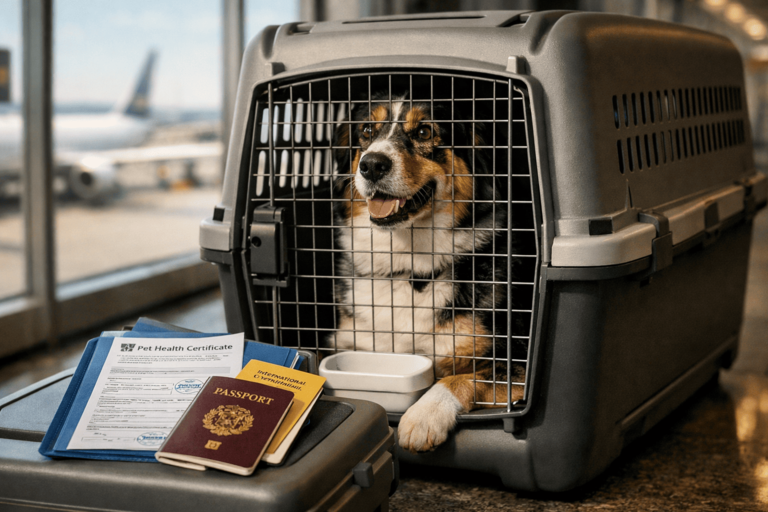
If you are planning to move, travel, or ship a dog to the United States in 2026, understanding the new rules from the Centers for Disease Control and Prevention (CDC) is absolutely critical. Since August 2024, the CDC has tightened entry requirements, and in recent months the official CDC Dog Import Form has been updated. Every traveler entering the U.S. with a dog must now use this form, with no exceptions. At Pet Global Cargo we help hundreds of families every year through this process, and we have seen firsthand how even a small error can cost you a day-long detention at the airport or, in the worst cases, a denied entry.
This guide walks you through what the CDC requires in 2026, what has changed compared to previous years, which documents you need, and the most common mistakes we see when owners try to handle the paperwork on their own.
Why did the CDC change the rules for importing dogs?
The United States eliminated canine rabies decades ago, but the virus is still active in many regions around the world. Every time a dog enters from a country classified as high-risk, there is a chance of reintroducing the disease. That is why the CDC has built a country-by-country classification system and requires specific documentation depending on the dog’s origin.
The core goal is public health, but the rules also protect the dog: an animal without a microchip, without a valid vaccine, or with missing documents may be turned away at the border, and no one wants to live that experience with their companion standing next to them.
The 3 basic requirements that apply to EVERY dog in 2026
Regardless of the country your dog is traveling from, these three requirements are mandatory:
- ISO-compatible microchip: the dog must carry a 15-digit microchip that meets ISO 11784/11785 standards. U.S. authorities will not accept any other format.
- Minimum age of 6 months: puppies younger than six months old are no longer allowed to enter. This is an important shift compared to older regulations.
- Healthy appearance: the dog cannot show any signs of illness at the time of entry. Inspectors may perform a visual examination.
In addition, travelers must complete the CDC Dog Import Form before the trip. The receipt is valid for 6 months from the date of issue, as long as the dog has not visited a high-risk country during that period.
The big difference: high-risk countries vs. low-risk or rabies-free countries
This is the point most owners get confused about. The CDC divides countries into two broad groups, and the requirements change dramatically.
Dogs traveling from rabies-free or low-risk countries
If your dog lives in a country that is rabies-free or low-risk, you only need to meet the three basic requirements (microchip, age, and healthy appearance) and present the CDC Dog Import Form. The CDC does not require a rabies vaccine in this scenario, although veterinary authorities in the origin country, and in many cases the destination state inside the U.S., often do.
Dogs traveling from high-risk countries
If the dog comes from a country classified as high-risk for canine rabies, the requirements multiply. You will typically need:
- A valid rabies vaccine (primary dose given at least 28 days before travel).
- A vaccination certificate validated by an official veterinarian.
- Serological titer test results in certain cases.
- A pre-booked slot at a CDC-approved facility upon arrival, depending on the case.
Before you buy your ticket, always check the current classification of the country your pet is departing from. The list can change and updates are not always announced far in advance.
The new CDC Dog Import Form: what it looks like and how to complete it properly
The CDC recently refreshed the design and formatting of the import form receipt. While the new look is cleaner, the content and requirements remain the same: the form is mandatory for every dog, without exception. It is completed online on the official CDC website, and the system generates a receipt that travelers must print or save on their phone to show upon arrival.
The form asks for details such as the dog’s microchip number, the country of departure, travel dates, the U.S. port of entry, and information about the person handling the transport. Simple as it may look, this is one of the most common sources of errors we see: travelers who input the wrong date, pick a port of entry that does not match the real flight, or use a microchip number that does not match the vet paperwork.
The 5 most common mistakes when importing a dog into the United States
- Assuming the dog can enter without a rabies vaccine. Many travelers believe their country is exempt, but even if the CDC does not always require the vaccine, the airline and/or the destination state often do.
- Filling out the CDC Dog Import Form too close to the travel date. It is legally valid, but it leaves no room to fix errors.
- Not verifying whether the microchip is readable with ISO scanners. An older or non-standard chip could force you to bring your own reader to the airport.
- Using a crate that does not meet IATA standards. The paperwork may be perfect, but if the kennel is non-compliant, the airline will refuse to board the dog.
- Forgetting that individual U.S. states may add their own requirements (international health certificate, parasite tests, etc.). The CDC only sets the national minimum.
How long does it take to prepare the trip?
For a dog in perfect health traveling from a low-risk country, the full process takes around 4 to 6 weeks. If the dog is coming from a high-risk country, or if it does not yet have a microchip or updated vaccines, you should plan 3 to 6 months in advance, especially when a serological test is required. That is why one of the most important tips we can give you is simple: do not wait until the last minute.
DIY or hiring a professional service?
Do-it-yourself is absolutely possible and every year thousands of owners pull it off, particularly when flying with a small dog in the cabin from a low-risk country. However, when you add international layovers, large dogs flying in the hold, brachycephalic breeds with special restrictions, or paperwork from a high-risk country, the margin for error becomes very narrow.
At Pet Global Cargo we specialize in exactly that: we coordinate microchipping, double-check the CDC Dog Import Form, work directly with airlines that still accept pets, and accompany your dog to the final destination. Our team stays up to date on every regulatory change, including recent CDC updates and the new IATA rules taking effect in 2026.
Conclusion: planning today saves headaches tomorrow
Importing a dog into the United States in 2026 is absolutely doable, but it can no longer be done overnight. The new CDC rules, combined with stricter airline policies, demand careful planning, accurate documentation, and a clear understanding of the legal framework. If you have questions about the specific requirements that apply to your case, reach out to us: we will review your pet’s situation and give you a clear, step-by-step travel plan so that arriving in the U.S. is as smooth as it should be.
Sources:
• CDC – Bringing a Dog into the U.S.